
Alright, let’s discuss educating your team about artificial intelligence. To put it simply, improving your workforce through AI skills training is about giving your staff members the ability to comprehend, apply, & even create artificial intelligence tools and concepts that are pertinent to their jobs, which will increase their productivity and make your company more competitive. It’s not about making everyone a data scientist overnight, but rather about developing fundamental knowledge & useful skills that can revolutionize work processes. Consider it like updating your team’s operating system for the contemporary business environment.
AI is not some far-off idea; it is already present and integrated into many facets of our everyday tasks, such as chatbots for customer support and intelligent search features. Businesses that ignore this change are exposed to both internal inefficiencies and competitors. The Changing Work Environment.
In today’s rapidly evolving job market, the importance of AI skills training programs cannot be overstated. Companies are increasingly seeking employees who are proficient in artificial intelligence and machine learning technologies. For those interested in enhancing their skills, a comprehensive resource can be found in a related article that discusses various training opportunities available in Malaysia. You can explore this valuable information by visiting this link, which outlines the offerings of a leading training provider in the region.
The labor market is changing quickly. Artificial intelligence is increasingly automating repetitive, manual tasks. This isn’t necessarily a threat, but rather a chance to retrain and upskill your employees to concentrate on higher-value tasks that call for human creativity, critical thinking, and emotional intelligence—exactly the areas where AI is currently lacking.
Closing the Skills Gap. Businesses’ current workforce’s skills and the AI skills they require are very different. This is about investing in the talent you already have, not just recruiting new talent. Reskilling current workers is frequently more economical & good for morale than continuously looking for new hires.
Join us for an exciting Training Seminar on quantum facilitation techniques.
It’s important to remain competitive. Companies gaining a competitive edge are those that adopt AI early and successfully. This covers everything from speeding up product development to streamlining supply chains and enhancing customer experiences. These AI-powered advancements are propelled by a skilled labor force.
As organizations increasingly recognize the importance of AI skills in today’s job market, many are turning to specialized training programs to equip their workforce. A related article discusses an innovative program designed for Quantum Facilitators, which aims to enhance skills in both AI and quantum technologies. This program not only focuses on the technical aspects but also emphasizes the importance of leadership in navigating these complex fields. For more information, you can read about it in this insightful piece on Quantum Facilitator training.
Knowing what your team truly needs is essential before you begin a training program. Rarely does a one-size-fits-all strategy work. carrying out a skills audit.
Determine your team’s current status first. This entails evaluating present AI literacy & pinpointing gaps in fundamental understanding or useful application. A clear picture can be painted with the use of surveys, interviews, and even small pilot projects. Deep Dives Specific to a Department.
Different departments will require different things. Product development may concentrate on machine learning in their software, while marketing may need to comprehend AI for tailored campaigns. Marketing & Sales: Recognizing AI for trend forecasting, personalized content creation, & customer segmentation. Customer service includes learning how to collaborate with AI chatbots, utilizing AI to assess customer sentiment, & efficiently escalating complicated issues. Operations & Logistics: Using AI for equipment predictive maintenance, inventory control, & route optimization.
HR: Using AI for performance analysis, employee experience optimization, & talent acquisition. Finance: Using AI to forecast finances, detect fraud, and evaluate risks. Future-Proofing vs. instant profits. Take into account both short-term requirements that can enhance present procedures and long-term requirements that get your business ready for upcoming AI developments.
A quick victory with a simple AI tool can occasionally create momentum for later, more in-depth training. It’s time to create a program that truly meets your needs once you’ve determined what you need. This is not about long, dull lectures.
Bite-sized & modular learning. Content that is simple to understand and instantly applicable is beneficial to adult learners. Divide difficult AI subjects into more manageable chunks. Foundational Knowledge: Start with the fundamentals, such as what artificial intelligence (AI) is, common terms related to AI (ML, neural networks, NLP), and ethical issues.
Tool-Specific Training: Give practical instruction for particular AI tools your business intends to use (e.g. “g.”. AI-driven writing assistants, particular analytics platforms, and predictive modeling software). Application Workshops: Emphasize how AI can address practical issues in your business. These are frequently the most interesting and beneficial. methods for blended learning.
To accommodate different learning styles and schedules, combine different learning techniques. Self-paced online courses: Coursera, edX, & LinkedIn Learning are some of the best resources available. Instructor-Led Workshops: An expert guide can be very helpful for more difficult subjects or practical application. Internal Mentorship Programs: Assist newcomers to AI by matching them with seasoned staff members or outside consultants. Hackathons and Innovation Challenges: Create a lighthearted, competitive atmosphere where staff members can try out AI fixes for business issues.
ensuring that it is applicable and useful. Employees’ daily tasks and the company’s goals should be directly related to the training. The impact of generic AI theory is less than that of demonstrating how AI can enhance a particular customer interaction or automate a particular report. Training doesn’t happen once. To fully incorporate AI into your workforce culture, you’ll need constant work and assistance. Leadership Advocacy and Buy-In.
The initiative will probably fail if the leadership isn’t on board. Leaders must advocate for the training, take part when necessary, & honestly convey its significance to the entire company. Their excitement is infectious. fostering an experimental culture. Encourage staff members to experiment with new AI tools and methods, even if they don’t always work out.
Make it safe to try new things & learn from your mistakes. This encourages creativity and lessens apprehension. Opportunities for ongoing education. AI is a rapidly developing field.
What is innovative today may become commonplace tomorrow. Give students constant access to up-to-date materials, advanced classes, and chances to attend conferences or workshops for the industry. Frequent Updates and Webinars: Educate the team on the latest advancements in AI and how they may affect their roles.
Internal AI Communities of Practice: Organize discussion boards where staff members can exchange best practices, pose queries, & work together on AI initiatives. Access to Experts: Ensure that when people run into AI-related problems, they have access to an internal or external resource for guidance & more in-depth insights. Adapting and Measuring Success. Establish precise metrics to determine how you will know the training is effective.
Rates of Participation: Are participants genuinely attending the training? Scores from the skill assessment: Are workers exhibiting increased comprehension & competence? Project Implementation: Are AI tools being successfully incorporated into workflows? Efficiency Gains/Cost Savings: Is it possible to measure the business impact of AI initiatives resulting from training?
Don’t be scared to modify your training plans in response to feedback & outcomes. Your efforts will remain impactful and relevant thanks to this iterative approach. You will probably encounter some obstacles even if you have the best of intentions. Many headaches can be avoided if you are ready for these.
Dealing with resistance and fear. Some workers may be concerned that AI will take their jobs or that they are too young or inexperienced to pick up new technology. These concerns can be allayed by open communication, highlighting AI as an augmentation tool, & presenting success stories. Emphasize how AI allows you to work more creatively and fulfillingly.
locating resources and trained instructors. AI knowledge is in great demand. If you have little internal expertise, you may need to search outside for consultants or specialized training providers.
Investigate collaborations with educational institutions or tech firms. Budgetary restrictions. Good AI training isn’t always inexpensive. Set the most important areas as your top priorities, begin small with pilot projects, & prove your return on investment to get more funding. Keep in mind that the long-term costs of not training your employees could be much higher.
Not enough application, too much information. It’s simple to become bogged down in AI theory. Make sure that your training consistently focuses on real-world applications and how staff members can apply these skills in their current roles.
Here, practical exercises and real-world case studies are very helpful. A lack of time. Workers are hard at work. Make training adaptable by providing choices for learning during off-peak hours or incorporating it into regular work schedules.
Long, drawn-out sessions are frequently inferior to short, powerful ones. Also, managers must specifically set aside time for their teams to participate in this development. The ultimate objective of AI skills training is to create an organization that is AI-fluent, meaning that workers at all levels are aware of the potential of AI, are able to engage with it successfully, and even contribute to its advancement. Adopting new tools is only one aspect of this; another is cultivating an innovative & constantly improving mindset.
By making investments in your workforce, you are actively creating the future rather than merely planning for it.
.
FAQs
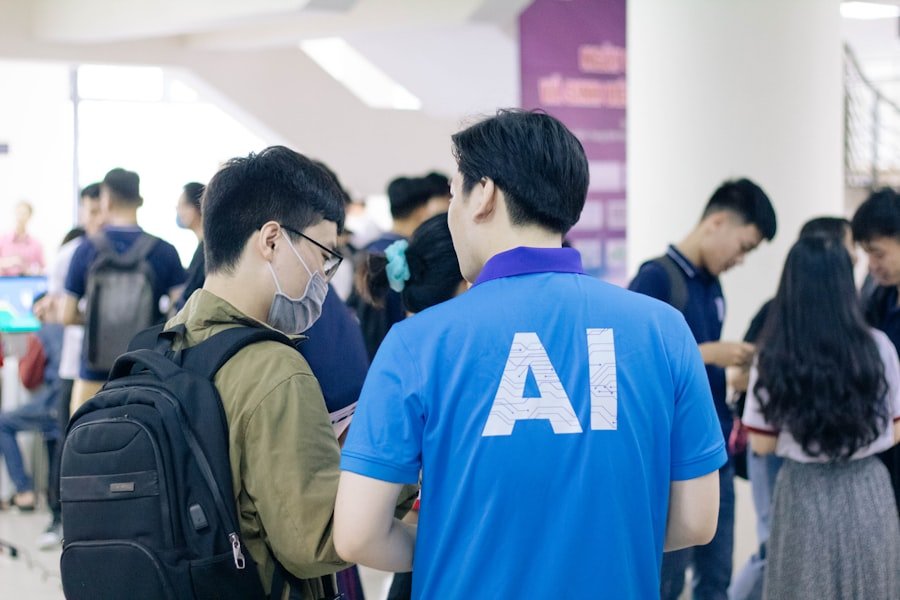
What is an AI skills training program?
An AI skills training program is a structured educational program designed to teach individuals the skills and knowledge necessary to work in the field of artificial intelligence. This may include programming, machine learning, data analysis, and other relevant skills.
Who can benefit from an AI skills training program?
Anyone with an interest in artificial intelligence and a desire to work in the field can benefit from an AI skills training program. This may include students, professionals looking to transition into AI-related roles, or individuals simply looking to expand their skill set.
What are the typical components of an AI skills training program?
An AI skills training program may include courses in programming languages such as Python, machine learning algorithms, data analysis techniques, and practical applications of AI in various industries. It may also include hands-on projects and real-world case studies.
How long does an AI skills training program typically last?
The duration of an AI skills training program can vary depending on the specific program and the level of depth it covers. Some programs may be as short as a few weeks, while others may span several months or even longer.
What are the potential career outcomes of completing an AI skills training program?
Completing an AI skills training program can open up a range of career opportunities in fields such as data science, machine learning engineering, AI research, and AI product development. Graduates may find employment in industries such as healthcare, finance, technology, and more.