
Hoping to make your sessions more interactive & fruitful? The secret usually hides in the facilitation methods you choose. Rather than merely delivering facts, skilled facilitation steers attendees through a path of exploration and teamwork. It involves crafting a space where everyone feels at ease pitching in, thoughts flow without restraint, and concrete results get delivered.
This isn’t only about being a strong speaker; it’s about acting as a savvy conductor, guiding a varied group toward a common aim. A productive gathering doesn’t simply occur; it’s carefully arranged & kicked off. The opening seconds are vital for establishing the mood, clarifying what’s ahead, and building a welcoming vibe. See it as placing a sturdy base before you begin constructing.
1. The Greeting & Icebreaker: Starting with Intention
Never overlook the impact of a strong beginning.
For those interested in enhancing their skills in workshop facilitation, a related article that offers valuable insights is available at this link: Workshop Facilitation Techniques for Trainers and Team Leaders. This resource provides practical strategies and tips that can help trainers and team leaders create engaging and productive learning environments, ensuring that participants are actively involved and able to achieve their objectives.
A friendly welcome goes past simple pleasantries; it’s about recognizing each person & making them comfortable. Follow this with a short, connected warm-up exercise. The aim isn’t just to “melt the frost” but to softly lead participants into the session’s subject or spark early connection tied to the content.
For example, instead of “share your preferred color,” try “tell us one thing you hope to take away from today” or “sum up a current hurdle related to [workshop topic] in a single word.” This instantly ties the exercise to the workshop’s goal and gets the ensemble thinking about the material. Keep it brief, inviting, and allow everyone to join in if they’d like, without force.
2. Outlining Goals & Schedule: Setting Expectations
Uncertainty is the foe of efficiency.
Discover the transformative potential of our coaching programs by exploring our website services. Our expert team is dedicated to helping you achieve your personal and professional goals. Visit our website services to learn more about our offerings.
Before jumping into the material, clearly state the workshop’s targets. What exactly will attendees have the ability to do or grasp by the finish? Make it concrete & trackable. Just as crucial is delivering a straightforward timetable.
For those interested in enhancing their skills in workshop facilitation, a valuable resource can be found in the article on Quantum Facilitator programs. This piece offers insights into advanced techniques that can significantly improve the effectiveness of trainers and team leaders. By exploring the principles outlined in this related article, facilitators can learn how to create more engaging and productive sessions that foster collaboration and innovation among participants.
This doesn’t call for a strict minute-by-minute plan, but rather a broad outline of the topics, tasks, and pauses. Visual aids such as a whiteboard or shared display work great for this. Clarifying the “reason” behind certain exercises or the general flow helps manage what’s expected and lowers worry about what’s unknown.
It also lets participants monitor their advancement and see how each part fits into the larger picture.
3. House Rules & Group Customs: Building a Secure Environment
Setting house rules or group customs at the start is essential for fostering a respectful and efficient space. This isn’t about forcing strict directives, but about jointly deciding how the group will interact. Ask participants what rules they feel will support effective collaboration. Typical examples include “pay attention carefully,” “one voice at a time,” “value different views,” “join in completely,” & “trust good intentions.” Write these down visibly and reference them if discussions drift off course.
This shared creation builds ownership and makes it simpler to softly remind attendees of their agreed standards when needed. It creates a mentally safe zone where everyone feels free to share thoughts without worry of criticism. The hallmark of an outstanding facilitator is their talent for bringing everyone into the action, pushing past passive listening toward active input. These methods are crafted to spark thinking, encourage conversation, and make sure varied viewpoints are captured.
4.
Reflect-Pair-Share: Boosting Individual and Group Contributions
Reflect-Pair-Share is a flexible and extremely useful method for deepening involvement and ensuring personal thought before team discussion. It works in three easy steps:
* **Reflect:** Present a query or issue to the group and allow 1-2 minutes of quiet time for them to ponder their own responses or concepts. This gives introverts room to process without instant strain and guarantees everyone can form a thought.
* **Pair:** Ask participants to team up with a neighbor (or a trio) & exchange their thoughts for 3-5 minutes. This establishes a low-risk setting for sharing first impressions, polishing them, and gaining another viewpoint. It boosts confidence before addressing the whole group.
* **Share:** Reunite the entire group and request pairs to present key takeaways or shared patterns from their chats. This yields a richer, more varied contribution than simply asking people to speak up initially.
It also cuts down on repetition since pairs often combine their ideas. This method is great for generating ideas, tackling issues, and reviewing sessions.
5. Circle Share & Spontaneous Sharing: Making Every Voice Heard
* **Circle Share:** This method ensures every single person gets a turn to speak on a certain subject. Move around the room (or virtual grid) and ask each participant, one by one, to offer one thought, reply, or observation. It’s especially handy when you need a thorough range of opinions, guarantee fair input, or quickly confirm understanding.
You can set a time limit per person (e.g., “reply in one sentence”) to keep things moving. It can also be tweaked to let participants “skip” if they truly have nothing to add right then, lowering stress.
* **Spontaneous Sharing:** As opposed to the orderly Circle Share, Spontaneous Sharing is a more free-flowing approach. After posing a question, invite participants to “pop” their answers out as they occur. This fosters a livelier & less formal sharing environment. It’s perfect for brainstorming, fast feedback, or when you want a burst of ideas.
The facilitator’s job here is to steer the flow, making sure one person doesn’t take over and gently prompting others to join. You could say, “What other thoughts are popping up?” or “Does anyone else want to jump in?”
Both methods are helpful, with Circle Share offering order and guaranteed participation, and Spontaneous Sharing providing energy and informality.
6. Small Team Splits (Chat Groups): Deepening Dialogue
Dividing the main group into smaller teams (often called “chat groups”) is a highly powerful way to deepen conversation, handle complex issues, and promote closer collaboration. The best size is usually 3-5 people.
* **Clear Directions:** Offer very clear directions for each team: What exactly is their job? What’s the expected result (e.g., “three actionable steps,” “a list of pluses & minuses,” “a recap of main hurdles”)?
What’s the time limit?
* **Facilitator Role:** While teams are working, the facilitator moves around, listening, offering hints if needed, & ensuring teams stay on track. Avoid becoming a member of any team; your role is to support all teams.
* **Reporting Back:** After the split, bring everyone back together for each team to share their findings. This combines the varied work and lets everyone gain from the small team talks. You can use boards, whiteboards, or digital tools for reporting.
This also creates accountability for the small team work. Splits boost involvement, let more voices be heard, and provide a safer space for people to express half-formed ideas before sharing with the larger group.
7. Votes & Instant Surveys: Quick Reactions & Involvement
In both on-site and remote settings, voting & instant surveys are excellent for checking understanding, gathering fast opinions, or reaching a decision.
* **Tools:** For on-site, simple hand raises, dot voting (placing stickers next to options on a board), or anonymous paper slips work well. For remote, built-in polling features in platforms like Zoom, Mentimeter, Slido, or Miro are invaluable.
* **Purpose:** Use polls to:
* Verify understanding (“On a scale of 1-5, how obvious is this idea?”).
* Collect opinions (“Which choice do you favor?”).
* Rank ideas (“Which of these three suggestions should we tackle first?”).
* Launch a discussion (“What share of you think X is accurate?”).
* **Discussion:** Always follow up a poll with a short chat about the outcomes. “Why do you think most people voted for A?” or “For those who picked C, what was your logic?” This turns a simple data point into a valuable learning or choice-making opportunity. Voting is efficient, inclusive (since it encourages replies from everyone), and gives immediate, measurable data that can guide later steps in the session. Moving past basic talk, these methods are designed to actively spark fresh concepts, organize details, and collaboratively tackle challenges.
8.
Brainstorming Varieties: Volume Over Polish (First)
Brainstorming is a classic, but how you lead it makes all the difference. The core idea stays: generate as many ideas as possible without criticism in the early phase.
* **Free-for-All:** The most frequent form, where participants call out ideas, and a facilitator writes them all down. Key rules: no criticism, no debate, build on others’ notions.
This works best with smaller, highly engaged crowds.
* **Brainwriting (or 6-3-5 Method):** For larger or quieter groups, or when you want to guarantee all voices are included. Each person writes down 3 concepts on a sheet of paper. They then pass their paper to the next person, who adds 3 more concepts, expanding on or creating new ones, for 5 rounds. This generates 108 concepts from 6 people in about 30 minutes! It’s less scary & produces a high quantity of ideas.
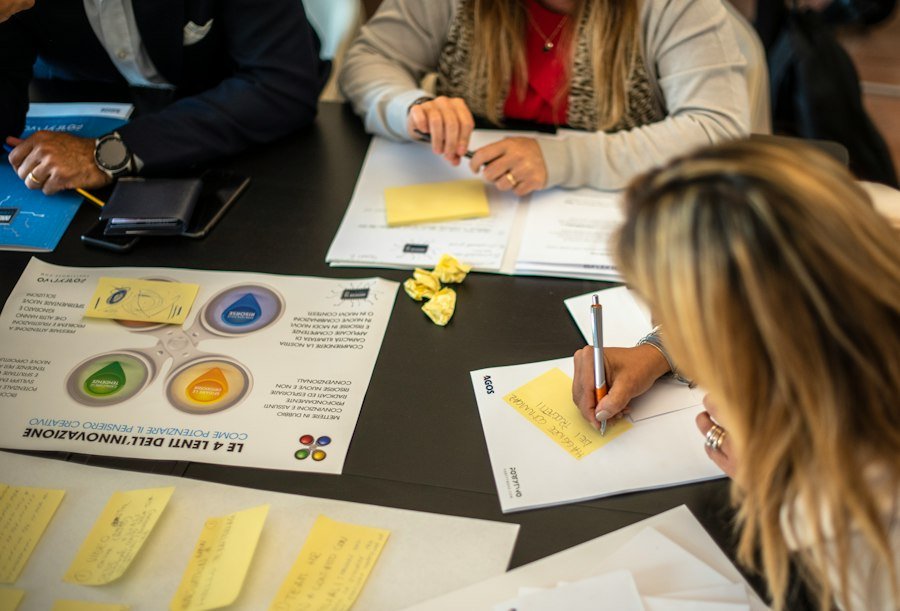
* **Silent Brainstorming (Sticky Note Storm):** Give everyone a pile of sticky notes & a marker.
Pose a question and allow 5-10 minutes for silent writing of one concept per sticky note. Then, have them place their notes on a wall or board. This avoids groupthink & makes sure introverts have ample time to contribute.
Notes can then be grouped and reviewed.
FAQs
What are workshop facilitation techniques?
Workshop facilitation techniques are methods and strategies used by trainers and team leaders to guide participants through a workshop or training session. These techniques help create an engaging environment, encourage participation, and ensure that the objectives of the workshop are met effectively.
Why are facilitation techniques important for trainers and team leaders?
Facilitation techniques are crucial for trainers and team leaders as they enhance communication, foster collaboration, and promote active learning among participants. Effective facilitation helps to manage group dynamics, address conflicts, and keep the workshop focused on its goals, ultimately leading to better outcomes.
What are some common facilitation techniques used in workshops?
Common facilitation techniques include brainstorming, group discussions, role-playing, icebreakers, and the use of visual aids. These techniques can help stimulate creativity, encourage participation, and facilitate deeper understanding of the topics being discussed.
How can trainers assess the effectiveness of their facilitation techniques?
Trainers can assess the effectiveness of their facilitation techniques through participant feedback, observation of group interactions, and evaluating whether the workshop objectives were achieved. Surveys, informal discussions, and reflection sessions can provide valuable insights into the participants’ experiences and learning outcomes.
What skills are essential for effective workshop facilitation?
Essential skills for effective workshop facilitation include active listening, adaptability, conflict resolution, time management, and the ability to engage and motivate participants. Strong communication skills and emotional intelligence are also important for understanding group dynamics and fostering a positive learning environment.